Your Brain’s Early Warning System: 4 Science-Backed Takeaways to Outrun Cognitive Decline
The Silent Shift
In the framework of Medicine 3.0, the greatest mistake we can make is viewing cognitive decline as a binary state—either you have it, or you don't. Modern neurology reveals a much more urgent reality: the neuro-pathological trajectory of dementia begins at least 20 years before the first "senior moment" or bout of brain fog occurs. By the time clinical symptoms manifest, the brain has often already undergone significant structural remodeling.
However, as the World Health Organization (WHO) explicitly states, dementia is "not a natural or inevitable consequence of ageing." Cognitive health is a modifiable trajectory, not a predetermined destination. To maintain healthspan and cognitive longevity, we must identify and mitigate subclinical shifts in our biology. This post distills the highest-signal data from recent research—ranging from genetic precision medicine to glymphatic clearance—to provide you with an early warning system for your most vital organ.
The Otic-Cognitive Axis: Why Hearing Care is Primary Prevention
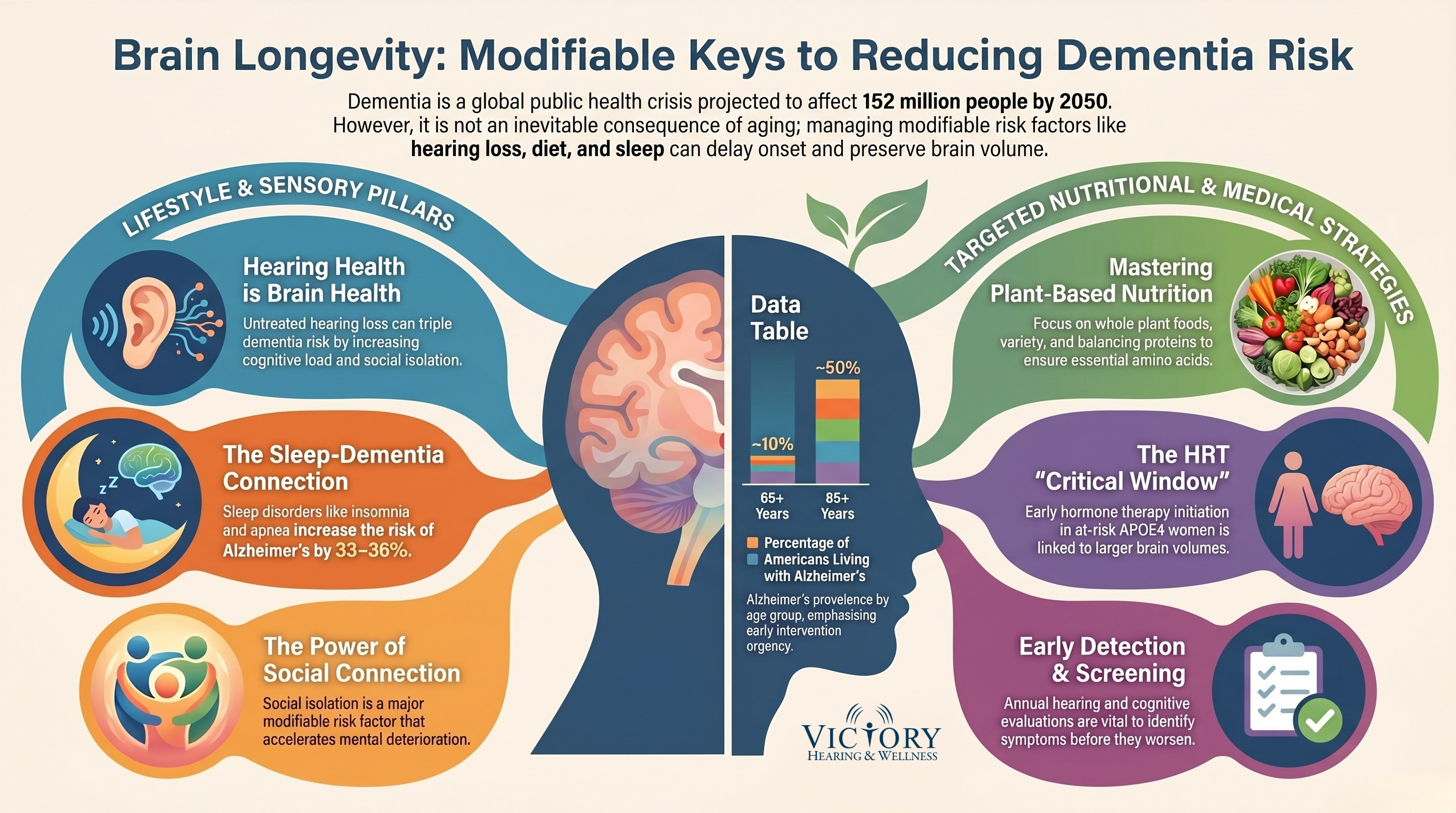
Perhaps the most overlooked "early warning" isn’t found in a memory test, but in the ears. Recent research from Johns Hopkins University has identified an irrefutable link between hearing impairment and neurodegeneration. Individuals with moderate hearing loss are three times as likely to develop dementia. Strikingly, in subcohorts over the age of 60, hearing loss accounts for a staggering 36.4% of the attributable risk for incident all-cause dementia.
The biological mechanisms driving this are threefold:
Cognitive Load: When the brain is forced to dedicate excessive resources to decoding sound, it occurs at the expense of systems dedicated to memory and executive function.
Gray Matter Shrinkage: A lack of auditory stimulation can lead to actual atrophy in brain regions responsible for sound processing, which then cascades into adjacent regions.
Social Isolation: Difficulty communicating leads to social withdrawal, which is a known accelerator of mental deterioration.
In a proactive longevity protocol, a baseline audiogram is not elective—it is a primary pillar of prevention. As providers in this space emphasize:
"Hearing loss is one of the most modifiable dementia risk factors."
Genetic Precision: The HRT "Critical Window" for APOE4 Carriers
For women, the menopausal transition represents a period of acute vulnerability due to estrogen decline. However, the 2023 Saleh et al. study from the European Prevention of Alzheimer’s Dementia (EPAD) cohort provides a landmark case for precision medicine. The data suggests that Hormone Replacement Therapy (HRT) is not a universal neuroprotective tool, but its benefits are profound when applied to the right genetic profile.
The study found that HRT benefits were almost exclusively isolated to carriers of the APOE4 gene—the strongest common genetic risk factor for Alzheimer’s. In APOE4 carriers, HRT use was associated with 6-10% larger volumes in the entorhinal cortex and amygdala. Conversely, the researchers noted a conflicting data point: non-APOE4 carriers using HRT actually showed smaller amygdala volumes compared to non-users. This highlights the absolute necessity of genetic testing before initiating hormonal interventions.
Furthermore, the "critical window" hypothesis was reinforced: HRT is most effective when introduced during the menopausal transition, before irreversible neuronal damage accumulates.
"HRT introduction is associated with improved delayed memory and larger entorhinal and amygdala volumes in APOE4 carriers only."
Glymphatic Stasis: How Sleep Fragmentation "Clogs" the Brain
Sleep is not merely downtime; it is the brain’s essential "cleaning cycle." A 2025 meta-analysis published in GeroScience highlights how sleep disorders act as biological accelerators of proteopathic buildup.
The primary mechanism is the failure of the "glymphatic clearance" system. During deep sleep, this system flushes out neurotoxic proteins, including amyloid-β. When sleep is fragmented by insomnia or obstructive sleep apnea, the brain enters a state of "glymphatic stasis," allowing toxic waste to accumulate.
The data highlights a significant risk shift:
Insomnia increases the risk of all-cause dementia by 36%.
Obstructive Sleep Apnea increases all-cause dementia risk by 33%, and specifically elevates Alzheimer’s risk by 45%.
Crucially, Medicine 3.0 practitioners view sleep disturbances as both a causal factor and an early biomarker. Disrupted sleep can be a prodromal sign of neurodegeneration, making early detection and treatment (such as CPAP or CBT-I) vital for maintaining structural brain integrity.
Metabolic Optimization: Strategic Plant-Based Protein Pairings
Nutritional strategies for brain health are shifting from restrictive diets to optimizing the nitrogen balance required for neurotransmitter synthesis. Success in plant-based nutrition for the brain is about "variety and balance, not restrictions."
The challenge lies in the amino acid profile. Because many plant proteins are "incomplete," they require strategic pairing to provide the full spectrum of essential amino acids. High-signal "Complete Protein Pairings" include:
Legumes + Grains: Pairing beans and rice.
Nut Butters + Whole Grains: Peanut butter on whole-grain bread.
To maintain steady cognitive focus and prevent metabolic energy dips that stress the brain, aim to eat every 3-4 hours. Given the importance of structural health, supplement with Vitamin B-12 and high-quality Omega-3 fatty acids, as these are often deficient in plant-only protocols but essential for preventing neuroinflammation.
Mastering the Lifestyle Score
The BMJ recently highlighted a "Healthy Lifestyle Score" that can significantly counteract genetic risk. While carrying the APOE4 allele increases your baseline vulnerability, a favorable lifestyle score can effectively slow memory decline and alter your neuro-pathological trajectory.
Your brain health is a dynamic metric. To transition from a passenger to a driver of your cognitive future, adopt this "Brain Builder" micro-challenge:
Vascular Clearance: Achieve 150 minutes of Zone 2 cardio weekly to drive vascular and glymphatic clearance.
Otic Health: Schedule a baseline audiogram and annual evaluations.
Nutritional Precision: Utilize strategic protein pairing and supplement B-12 and Omega-3s.
The Final Question: If you could delay the onset of cognitive decline by just one year through a single habit change, which of these four findings would you act on first?