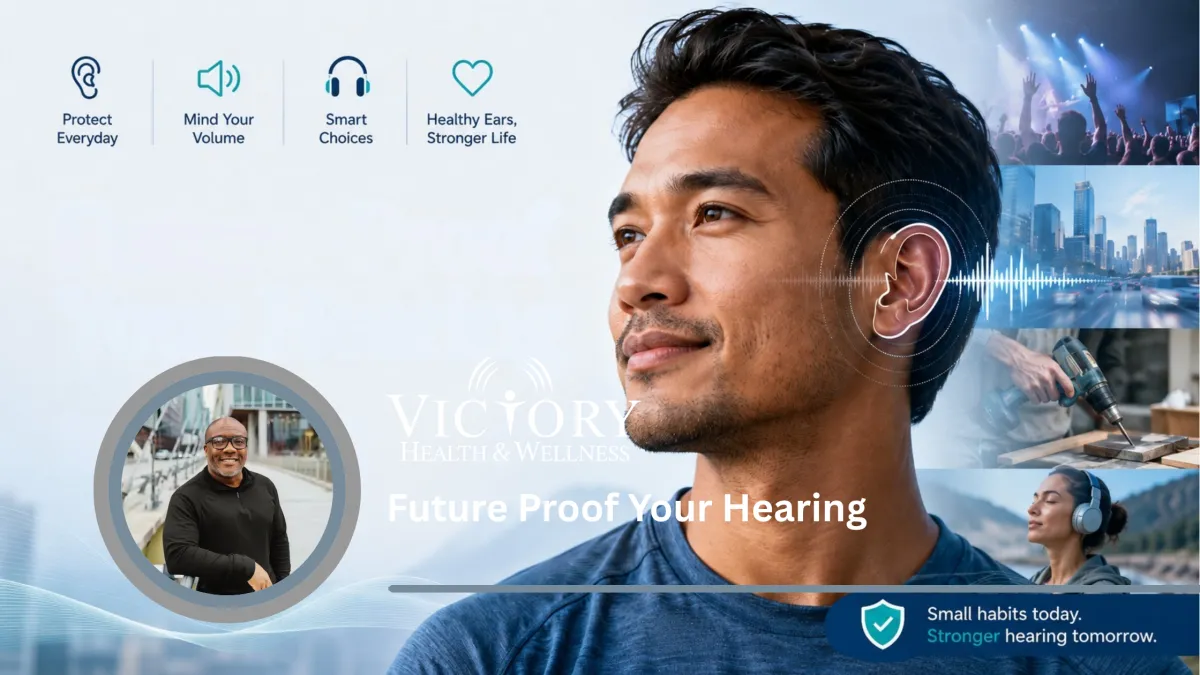
Future-Proof Your Hearing
Everyday Habits That Can Protect Your Ears for Life
We often think of hearing loss as something that happens naturally with age. While aging, genetics, medical conditions, and certain medications can affect hearing, a significant portion of hearing damage is connected to something we can influence: repeated exposure to excessive sound.
The important truth is that hearing damage does not always happen during one dramatic event. It can develop gradually through ordinary activities—listening through headphones, attending concerts, mowing the lawn, using power tools, riding a motorcycle, watching fireworks, or spending time in loud sporting venues.
You may leave these environments feeling completely normal. However, each exposure contributes to your lifetime sound dose.
That is why protecting your hearing should not begin after you notice a problem. It should become part of your overall wellness strategy today.
Why Loud Sound Can Permanently Affect Hearing
Deep inside the inner ear is a small, fluid-filled structure called the cochlea. Within the cochlea are delicate sensory hair cells that help convert sound vibrations into electrical signals the brain can interpret.
When sound is excessively loud, too close, or continues for too long, these cells can become overstressed or permanently damaged. Unlike muscle tissue, these sensory cells do not reliably regenerate in humans.
Noise-related hearing risk is influenced by three primary factors:
Volume: How loud is the sound?
Duration: How long are you exposed?
Distance: How close are you to the source?
As sound intensity rises, the amount of time you can safely remain exposed decreases. A moderately loud environment may become hazardous after prolonged exposure, while fireworks, gunfire, explosions, or extremely loud speakers can cause damage much more quickly. (NIDCD)
Hearing Loss Is Not Only an Older-Adult Concern
Children, teenagers, working-age adults, musicians, recreational shooters, fitness professionals, motorcyclists, landscapers, construction workers, and frequent concertgoers may all experience harmful sound exposure.
The World Health Organization estimates that more than one billion young adults are at risk of permanent, avoidable hearing loss because of unsafe listening practices. Hearing loss can affect communication, education, employment, social participation, and emotional well-being at virtually any age.
The unspoken truth is that feeling young and healthy does not make the inner ear resistant to damage. Your ears do not know whether the sound is coming from a worksite, a workout playlist, a stadium, or your favorite artist.
They respond to the total sound exposure.
Common Sources of Everyday Hearing Risk
Headphones and Earbuds
Personal listening devices can deliver sound directly into the ear for hours at a time. Risk increases when the volume is raised to overcome traffic, gym music, airplane noise, lawn equipment, or other background sound.
A practical warning sign is needing to remove your headphones to understand someone standing nearby—or being unable to hear that person without them shouting.
Use built-in listening notifications, volume limits, and exposure reports when available. Noise-canceling or well-fitting sound-isolating headphones may also help you hear clearly without turning the volume as high.
Concerts, Festivals and Sporting Events
Concerts and stadiums regularly reach levels where unprotected listening can become hazardous in a relatively short period.
High-fidelity or musician-style earplugs are designed to lower overall sound while preserving more of the clarity and balance of music. Custom hearing protection may provide greater comfort and consistency for frequent attendees, performers, music professionals, or venue employees.
Earplugs do not eliminate the experience. They reduce the intensity reaching the inner ear so you can continue enjoying music in the future.
Lawn Equipment and Power Tools
Lawnmowers, leaf blowers, trimmers, chainsaws, drills, saws, shop equipment, and other powered tools can produce harmful noise.
Use properly fitted earplugs, protective earmuffs, or both when the environment warrants dual protection. Do not assume that listening to music through ordinary earbuds underneath the noise makes the situation safer. It may lead you to increase the music volume further.
Fireworks and Firearms
Fireworks, firearms, explosions, and other impulse sounds can create extremely high sound levels within a fraction of a second.
Keep a generous distance from fireworks, avoid standing near launch areas, and provide children with well-fitting protective earmuffs. Adults need protection too.
For recreational shooting, properly fitted earplugs and earmuffs are often used together. Professional guidance is particularly valuable because the protection must reduce hazardous impulse noise while still allowing safe communication and environmental awareness.
Motorcycles, Convertibles and Open Car Windows
Wind noise at highway speeds can become more intense than many drivers and riders realize. Motorcyclists may experience prolonged wind and engine exposure, while drivers who routinely travel with one window open may expose one ear more than the other.
Appropriate filtered hearing protection can reduce excessive wind noise while preserving awareness of traffic, horns, sirens, and other safety signals.
Understanding Hearing-Protection Ratings
Hearing protectors sold in the United States generally display a Noise Reduction Rating.
The NRR can help compare products, but it does not guarantee that every person will receive that amount of protection. The rating is derived under controlled laboratory conditions. Real-world protection depends on:
Correct insertion or placement
The shape of the ear canal
The seal around the ear
Facial hair, eyewear, hats, or other equipment
Whether the protector remains in place
Whether it is comfortable enough to wear consistently
A properly fitted product with a moderate rating may protect you better than a higher-rated product that is uncomfortable, poorly inserted, or frequently removed. NIOSH recommends fit testing as the most reliable method of determining how much protection an individual actually receives. (CDC)
Five Ways to Future-Proof Your Hearing
1. Turn Down the Volume
You do not need to eliminate music, podcasts, movies, or gaming. Lower the listening level and avoid gradually increasing the volume as your ears become accustomed to it.
2. Reduce Exposure Time
Take quiet breaks during concerts, sporting events, loud work, and other prolonged exposures. A short break in a quieter area can reduce your total sound dose.
3. Increase Your Distance
Sound intensity generally decreases as you move away from its source. Avoid standing directly beside concert speakers, fireworks launch areas, loud machinery, or amplified sound systems.
4. Wear the Right Protection
Choose hearing protection that fits the activity and that you will wear correctly for the entire exposure. Options include foam earplugs, reusable plugs, filtered musician plugs, protective earmuffs, and custom-molded devices.
5. Get a Baseline Hearing Evaluation
Do not wait until you are struggling to participate in conversations. A comprehensive evaluation can establish a baseline, identify early changes, assess one ear separately from the other, and provide personalized guidance based on your lifestyle and exposure history.
The CDC recommends turning down the volume, moving away from loud sound, taking listening breaks, avoiding unnecessary noise, and using hearing protection whenever hazardous sound cannot be avoided. (CDC)
Warning Signs You Should Not Ignore
Schedule a hearing evaluation when you notice:
Ringing, buzzing, humming, or roaring in the ears
Muffled hearing after a loud event
Difficulty understanding speech in restaurants or groups
Frequently asking people to repeat themselves
Turning the television or phone volume higher
Trouble hearing children or higher-pitched voices
Difficulty determining where sounds are coming from
A noticeable difference between your ears
Sound sensitivity or discomfort
Ear pressure, fullness, drainage, pain, or dizziness
Tinnitus or temporary muffled hearing after noise exposure should not be treated as proof that your ears “recovered.” Temporary symptoms may still indicate that the auditory system was overstressed. Noise exposure can also cause permanent hearing loss without obvious ringing afterward. (AP News)
Sudden hearing loss, especially in one ear, requires urgent medical evaluation.
Hearing Health Is Whole-Person Health
Hearing allows us to communicate, maintain relationships, participate in our communities, respond to our surroundings, and remain engaged in meaningful activities.
When hearing becomes difficult, people may work harder to follow conversations, avoid challenging environments, withdraw socially, or feel less confident. Unaddressed hearing loss has also been associated with social isolation, loneliness, cognitive decline, and reduced quality of life, although an association does not automatically establish direct causation
Protecting your ears is therefore not simply about preserving your ability to detect sound. It is about protecting communication, connection, independence, safety, and long-term brain health.
Start Protecting the Hearing You Have Today
You cannot control every factor that affects hearing, but you can control many of your daily exposures.
Carry hearing protection with you. Respect your device’s listening alerts. Step away from speakers. Protect yourself while using lawn equipment and power tools. Wear protection around fireworks and firearms. Give your ears quiet recovery time. Most importantly, establish a hearing baseline before difficulties begin interfering with your life.
At Victory Hearing & Wellness, our team evaluates hearing as part of a comprehensive, whole-person approach to health. We can help you understand your current hearing, identify potential risk factors, select appropriate hearing protection, and develop a personalized plan for long-term hearing wellness.
Your future self deserves to hear the conversations, music, laughter, and moments that matter most. Protect the hearing you have today.
Schedule Your Hearing Evaluation
Contact Victory Hearing & Wellness at (512) 443-3500 to schedule a comprehensive hearing evaluation or personalized hearing-protection consultation.
This article is intended for educational purposes and does not replace individualized medical or audiological evaluation.